The point-solution trap: why AI pilots don't scale
The default playbook is to buy AI one tool at a time. A copilot for sales. A document bot for legal. A forecasting add-on bolted onto the planning system. Each vendor runs a slick demo, and each demo works, because each tool only has to see its own slice of the business.
Then you try to scale. Every tool brings its own copy of your data, its own login, its own model, its own contract, and its own definition of the records it touches. Five tools in, you're paying for five integrations into the same ERP. You also have five places sensitive data now lives and five audit logs, and none of them can answer the question your auditor will ask: which system did what, against which record, and who approved it?
You also don't own any of it. The prompts, the workflows, the logic that encodes how your business runs: it all lives inside someone else's product, on their roadmap, priced on their terms. When a better model ships next quarter, you wait for the vendor to adopt it. If you want out, you start over.
What an AI-first operating model looks like
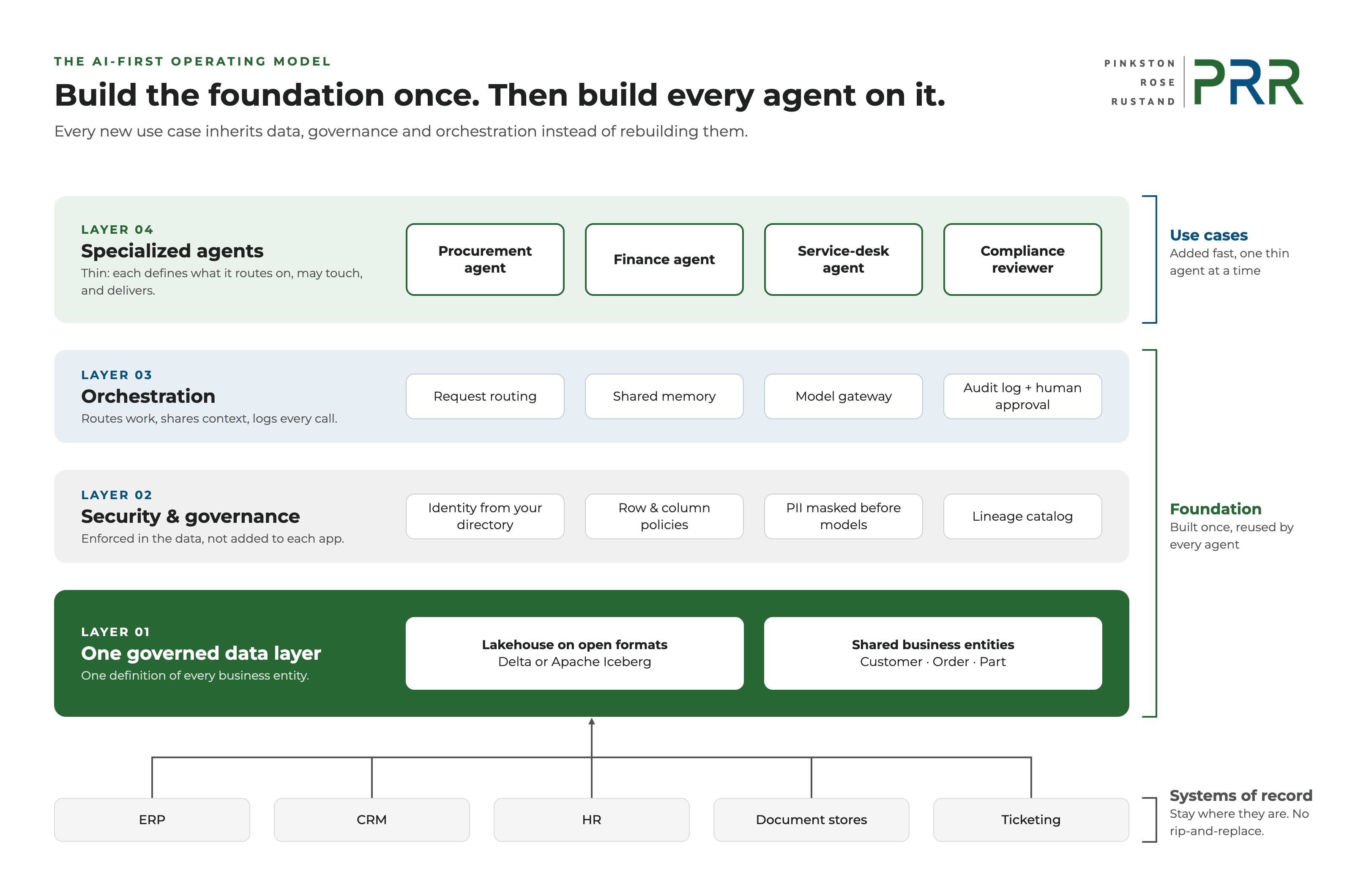
An AI-first operating model flips the order: you build one shared foundation for data, governance, and orchestration first, and every AI use case after it inherits that foundation instead of rebuilding it.
The foundation has four layers.
1. One governed data layer. Pipelines pull from the systems you already run (ERP, CRM, HR, document stores, ticketing, operational databases) into a lakehouse on open table formats like Delta or Apache Iceberg. Raw data lands, gets cleaned, and gets modeled into shared business entities. A customer, an order, a part: each gets one definition. The systems of record stay where they are. Nothing gets ripped out, and nobody runs a big-bang migration.
2. Security and governance built into the data, not added to each app. Access is enforced where the data lives. Identity flows from your directory. Row- and column-level policies decide who sees which records. PII gets masked before a model ever sees it. A catalog tracks lineage, so when an agent quotes a number, you can trace it back to the table and the load that produced it. In our own builds the boundary sits in the data layer on purpose. One governed analytics agent we built over a client's Databricks warehouse never gives model-generated SQL a warehouse connection. Queries run against a governed mart, each table gets checked against the asking user's role, and the system refuses instead of guessing when a question reaches past what that role can see.
3. Orchestration. A routing layer reads each request, pulls out the entities, and sends the work to the right agent. Agents hand work to each other with the context intact. Shared memory means a customer looked up once is known to every agent after. A model gateway sits between your agents and the model providers, so you can route a task to whichever model fits it and switch when a better one ships. Every call gets logged end to end, and any write to a system of record waits for a human to confirm it.
4. Specialized agents. This is the layer people picture when they say "AI": a procurement agent, a credit memo agent, a service-desk agent, a compliance reviewer. In an AI-first model each of these is thin. It defines what it routes on, what it's allowed to touch, and what a finished answer looks like. Everything underneath comes from the foundation.
Why the economics improve with every use case
The first use case carries the weight. It stands up the pipelines, the governance, and the orchestration. The second use case reuses all of it and ships faster. On one enterprise program we delivered, build effort on the fifth use case fell to roughly 40% of the first, because the plumbing already existed.
Compare that to the point-solution path, where use case five costs about what use case one did, plus another integration to maintain. One curve bends down. The other runs flat or climbs.
The value also compounds in a way point tools can't match. A procurement question that turns into a finance question stays in one conversation, because both agents read the same governed data and pass context over the same bus. Two separate SaaS products can't do that without a third integration project.
No vendor lock-in, and you own the code
We build every layer on open formats and components with equivalents on any major cloud: object storage, open table formats, event streaming, containers, and a model gateway that speaks to more than one LLM vendor. It runs in your tenant. The code sits in your repository.
That buys you three things.
You can swap any component without rewriting your agents. A new model, a cheaper vector store, a different cloud region. Each is a configuration change.
You keep your institutional logic. The rules that encode how your business underwrites a loan, approves a PO, or routes a ticket are your intellectual property. In an AI-first model they live in your codebase, versioned and reviewable, not inside a vendor's black box.
And you control the risk posture. Your security team reviews code you own, running in infrastructure you control, against data that never left your perimeter.
AI is moving too fast to rent your foundation
The frontier models change every few months. Capabilities that needed a custom pipeline last year ship as an API feature this year. Prices drop, context windows grow, new agent patterns show up constantly.
In that environment, a point solution freezes your company at the moment you signed the contract. You get the model the vendor picked, the workflow they designed, and their release schedule. An AI-first foundation lets you adopt each improvement the week it lands, because the model is one swappable layer in an architecture you own.
The data work doesn't go stale. Clean, governed, well-modeled data is the asset that makes every future model useful to you. The companies that build that foundation now will plug in each new capability as it arrives. The ones buying point tools will keep re-buying them.
Where to start with an AI-first operating model
You don't have to build the whole platform before you see value. Pick the use case with the most friction and a clear owner. Build it on the foundation from day one: real pipelines, real governance, real orchestration, scoped to what that first use case needs. It ships as working software, and it leaves behind the layer that the second, fifth, and twentieth use cases will run on.
You can keep buying AI one tool at a time. Or you can build the foundation once and own everything you put on top of it.